MapGame
whidevTrivia
4.640.00 Reviews
- Version
- 3.4.0
- Installs
- 100.00K
- Age Rating
- Everyone
Screenshots
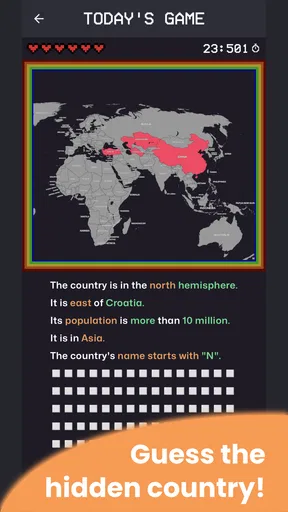
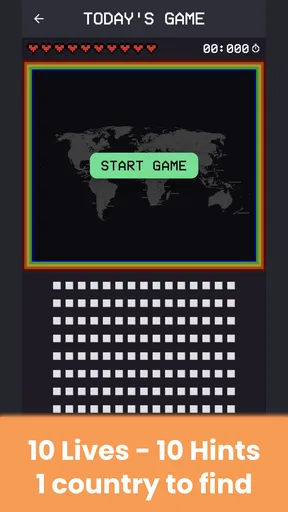
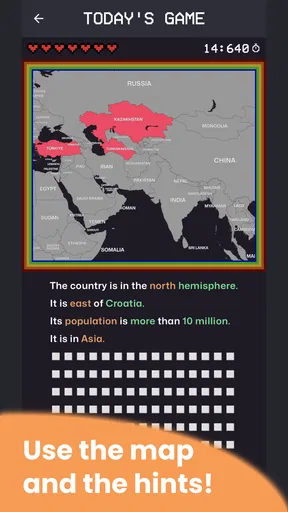
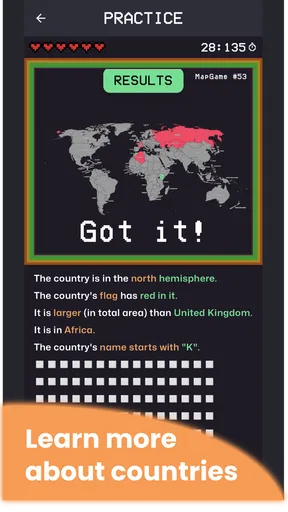
Our Review of MapGame
 Analysis by Appyee
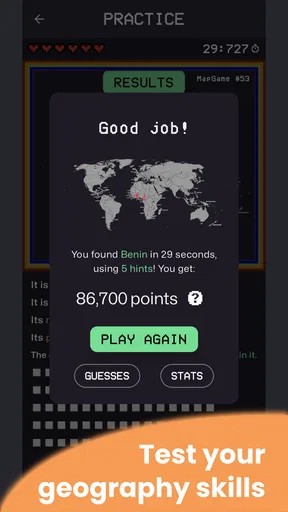
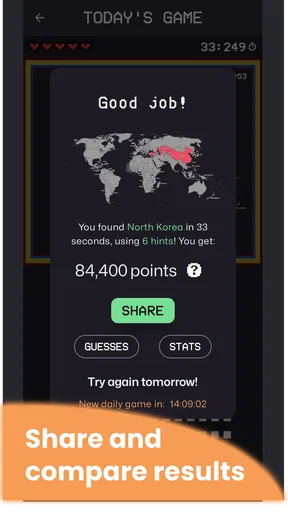
I enjoy trivia games most when they make me think without turning a short break into a complicated project. MapGame takes that simple idea and gives it a clear geography focus: a country is hidden on a map, and I have to work out which one it is. That makes each round feel more like a visual puzzle than a conventional question-and-answer quiz.
After spending time with it, I see the game as a good fit for people who like maps, country facts, and quick mental challenges. It is free to start, rated for Everyone, and developed by whidev. The basic appeal is easy to understand, but the real question is whether the map-based format stays interesting after the novelty fades. In my experience, it does best when I treat it as a focused geography workout rather than a large, all-purpose trivia platform.
How the map-based challenge feels in everyday play
The central task is deliberately narrow: identify the hidden country from its position on the map. That focus is a strength because I never have to learn a complicated ruleset before playing. I can open the game, look at the map, make a judgment, and move on to the next challenge. For a quick session while waiting for an appointment or taking a break from work, that direct structure is much more convenient than a trivia game filled with menus, categories, and long explanations.
The map changes the way I reason. Instead of recalling an isolated fact such as a capital or a historical event, I have to connect shape, neighboring regions, coastlines, and overall geographic position. Even when I recognize the answer quickly, the process still feels active because I am reading visual information. When I do not know the country immediately, I can narrow the possibilities by thinking about the surrounding area rather than guessing completely at random.
That makes the game particularly useful for casual learning. I would not use it as a complete geography course, but repeated rounds can expose weak spots in my world map knowledge. Countries that I once confused begin to occupy more distinct places in my memory. The learning is informal, which is also its limitation: the game encourages recognition and recall, but it should not replace a detailed atlas or structured study material when accuracy and depth matter.
The store presents it as “MapGame,” and that short identity is appropriate. This is not trying to be a broad trivia hub with dozens of unrelated subjects. Its personality comes from the map itself. Players who want sports, entertainment, science, or general-knowledge categories will probably find the experience too specialized. Players who enjoy geography will appreciate that the subject is not diluted by unrelated quiz content.
Why the first few sessions are easy to understand
The game has a low learning curve because the visual objective explains itself. I do not need to remember a long list of power-ups or manage a complicated progression system before I can enjoy a round. That matters on a phone, where a game that takes too long to explain often gets abandoned before it becomes enjoyable.
I also like the way the format rewards a pause before answering. Looking at the map carefully is more valuable than tapping quickly. I can inspect the position, compare it with nearby countries in my memory, and then commit. This gives the experience a calmer rhythm than trivia games built around countdown pressure, although anyone seeking constant action may find it restrained.
A useful personal habit is to separate certainty from familiarity. Sometimes a country looks familiar because its region is recognizable, but the exact borders are not. I get better results when I first identify the continent or broad area, then consider coastlines and neighbors, and only afterward choose the country. That simple three-step approach makes the game feel more like reasoning and less like blind recall.
Where it fits beside ordinary trivia games
Compared with a standard multiple-choice trivia app, this game asks me to interpret rather than simply recognize an answer among options. Multiple-choice quizzes can be more varied and may offer a wider sense of progression, but they also let me rely on elimination. Here, the map carries more of the challenge, so my actual geographic knowledge matters more.
Compared with a dedicated atlas or educational geography tool, the game is faster and more approachable. I am more likely to open it for a few minutes than to study a complete map. The trade-off is that entertainment comes first. An atlas can explain borders, regions, and context in detail, while this experience concentrates on the satisfaction of identifying a hidden location.
It also differs from multiplayer trivia. I do not approach it as a social competition or a loud party activity. Its appeal is personal improvement: remembering more, noticing patterns, and becoming less uncertain about countries that used to blend together. If my priority is competing with friends in real time, another type of quiz game would be a better choice.
Speed, stability, and practical use on a phone
I find that a map quiz is only as practical as it is easy to pick up and put down, so this section looks at how the phone experience fits into everyday gaps. I also consider the small habits that help me stay focused on geography rather than the screen itself. That practical view leads naturally to the question of how the game’s short rounds build a satisfying rhythm.
What to expect from everyday responsiveness
Because the core activity centers on viewing a map and making an answer, the experience feels naturally suited to short interactions. I do not expect the same kind of loading burden as a game built around large 3D scenes, streaming content, or elaborate animations. The design concept is lightweight in spirit, and that helps it feel appropriate for ordinary phone use rather than only for long, uninterrupted sessions.
Still, perceived speed is not only about how quickly a game opens. It is also about how soon I can understand the current challenge, how clearly the map responds to my attention, and whether the next round gets in the way of the rhythm. A geography game benefits from keeping the path between one answer and the next uncomplicated. When that flow is maintained, I can concentrate on the country instead of on the interface.
I would not choose it for a high-intensity gaming session where rapid animation and constant action are the main attractions. Its strength is quick mental engagement, not spectacle. That distinction is important: a player may call it “slow” simply because it is thoughtful, while another player may find that same pace comfortable and focused.
How heavy use changes the experience
Longer sessions reveal a natural trade-off. The first rounds can feel especially satisfying because I am testing familiar knowledge and discovering gaps. After extended play, the narrow subject may become repetitive for people who need constant variety. The game is easier to recommend as a repeatable short activity than as the only game on a phone.
I find it works well in several small-use situations. I can play a few rounds during a commute when I want something more constructive than scrolling, use it as a warm-up before studying geography, or pass it around during a family break because the Everyone age rating makes the subject approachable for a broad audience. It can also work as a friendly challenge between two people who compare guesses, even though the game itself is not something I would describe as a full social party title.
For heavy use, I would rotate it with another kind of puzzle or a fuller geography reference. That is not a criticism of the map format; it is simply the result of specialization. Repetition is useful for memorization, but variety helps prevent attention from dropping. I get the most from it when I return regularly rather than trying to play for hours in one sitting.
Reliability and recovering from interruptions
A trivia game needs to be dependable in a modest but important way: I should be able to return to it, understand the current challenge, and continue without feeling that a short interruption has ruined the session. The compact nature of the gameplay makes it suitable for stop-and-start use. If I put my phone away because a conversation begins or an errand calls me, the game is not demanding the kind of long commitment associated with a story-driven title.
My practical advice is to treat each round as a self-contained mental task. That makes recovery easier because I am not trying to remember a complicated chain of events. If I am interrupted after studying a map, I can simply reassess the visible location when I return. This is one of the quiet advantages of a focused quiz design.
At the same time, I would avoid assuming that every session will feel identical on every phone. App behavior can vary with the device, operating system, available storage, and what else is running. The game’s current version is 3.4.0, so keeping it updated is a sensible first step if I encounter unusual behavior. I also prefer closing unnecessary background apps before a longer session, not because this game appears demanding, but because it removes avoidable distractions and resource pressure.
Device limits and who should think twice
The minimum operating system is Android 9, which gives the game a reasonably clear compatibility boundary for Android users. Before installing, I would check that a phone meets that requirement rather than assuming that any older handset will run it. This is especially relevant for people keeping an older spare phone for casual games.
On a modern phone, I would expect the map-focused format to be less resource-intensive than visually ambitious games, but I would not turn that expectation into a promise about battery use or memory. The safest practical approach is to judge it alongside the rest of the phone: if the device already struggles with everyday apps, a new installation may not feel as smooth as it would on a newer model.
Screen size can also affect comfort. A larger display should make map details easier to inspect, while a very small screen may require more concentration and repeated checking. That matters because the challenge depends on visual reading. If I have difficulty seeing borders or the relevant area, the problem is no longer geography knowledge alone; it becomes an interface-comfort issue.
The game is free, which lowers the barrier to trying it. There are in-app purchases priced at $3.99 per item, so I would approach any optional spending deliberately rather than assuming that every useful part is included without cost. For someone who only wants occasional map puzzles, the free entry point is attractive. For a child’s device, I would still review purchase controls before handing the phone over, even with an Everyone rating.
Three ways I get more value from the format
First, I use wrong answers as a personal map-building exercise instead of immediately moving on. After a miss, I mentally place the country beside its neighbors and note the feature I overlooked: perhaps the coastline, the region, or the relative position. This turns a single mistake into a small memory hook, which is more useful than simply chasing a higher success rate.
Second, I create a regional rotation for myself. On one day I focus on recognizing broad continental placement; on another, I pay attention to countries with similar shapes or nearby borders. The game does not need a formal study mode for this workflow. I supply the structure by changing what I look for, which keeps repeated rounds from becoming automatic tapping.
Third, I use it as a diagnostic before choosing a deeper resource. If I repeatedly confuse countries in one region, that tells me where an atlas, map video, or textbook would be most helpful. In that role, the game is not competing with educational references; it is showing me what I need to review. That is a more realistic use than expecting a short trivia session to teach every geographic detail.
Who will enjoy it, and who may prefer something else
I would recommend it to casual learners, geography fans, parents looking for an approachable knowledge game, and anyone who enjoys visual puzzles more than rapid-fire general trivia. It is also a good option for people who want a free game they can sample without committing to a large download-heavy entertainment routine.
I would be more cautious about recommending it to players who need constant novelty, competitive multiplayer, rich sound and animation, or a broad collection of subjects. A person who dislikes maps may find the central mechanic repetitive no matter how well it works. Likewise, someone preparing for an advanced geography exam should use it as practice, not as the sole source of information.
The audience size suggests that it has found interest beyond a tiny niche: it has more than one hundred thousand installs and an average rating of 4.6 from around 1.7 thousand ratings. Those figures are encouraging, but they do not change the basic fit question. A well-liked specialized game can still be the wrong choice for someone seeking a different style of trivia.
My performance verdict
From a performance perspective, I see MapGame as a focused, low-pressure geography title rather than a demanding mobile game. Its map-centered design should suit short sessions, modest expectations, and phones that meet the Android 9 requirement. The most important performance advantage is not flashy speed; it is the ability to get into a simple mental challenge without a large amount of setup.
The main limitation is endurance. If I play for too long, the single subject can feel less varied than a general trivia app. The experience also depends on being able to read the map comfortably, so a small or older screen may make the challenge less pleasant even when the game itself is suitable for the device.
Overall, I think the free price makes it easy to recommend as a try-before-you-decide geography game. I would install it for short practice sessions, family guessing games, or a more thoughtful alternative to ordinary scrolling. I would skip it only if I wanted broad trivia categories, a strong social competition layer, or a visually intense game. For the right player, its narrow focus is exactly what makes it useful: it turns a map into a quick, repeatable test of real geographic awareness.
Released on October 31, 2023, and maintained by whidev, the game has a clear identity and a practical place on a trivia-focused phone. I would keep expectations realistic, use mistakes as learning prompts, and treat optional purchases as a choice rather than part of the reason to play. With that mindset, it is an enjoyable way to sharpen country recognition whenever I have a few spare minutes.
Verdict
Strengths of MapGame
- Turns map knowledge into an engaging game format.
- Suitable for quick sessions during commutes or breaks.
- Can help improve recognition of countries and locations.
- Appeals to both casual players and geography enthusiasts.
- Simple concept makes it easy to start playing quickly.
Limitations of MapGame
- May become repetitive after extended play sessions.
- Some locations can be difficult without prior geography knowledge.
- Accuracy may vary for disputed or obscure regions.
- Progression can feel limited for highly experienced players.
- Gameplay may depend on an active internet connection.
Similar Picks in This Category
View All
Millionaire 2026 Quiz & Trivia
Quiz & Trivia Games by Submarine Apps4.5

Brain Test 2: Tricky Stories
Unico Studio4.7

Trivia Crack: Brain Quiz Games
etermax4.4

QuizzLand. Quiz & Trivia game
Quiz & Trivia Games by Mno Go Apps4.8

Brain Test: Tricky Puzzles
Unico Studio4.7

Logo Quiz
bubble quiz games4.5
Frequently Asked Questions
What is MapGame and how does it work?
MapGame is an interactive geography-based game that challenges players to identify locations, countries, cities, landmarks, or regions using maps and visual clues. Gameplay can vary depending on the selected mode, but it generally combines exploration, quizzes, and timed challenges. It is designed for casual entertainment while also helping players improve their geographical knowledge through repeated practice.
Is MapGame free to download and play?
MapGame can generally be downloaded for free, although the exact availability of free content may depend on the version installed and the platform used. Some features, extra game modes, or ad-free access may require in-app purchases. Before downloading, users should check the current store listing for pricing, advertising details, subscriptions, and any optional purchases available within the application.
Does MapGame require an internet connection?
An internet connection may be required for downloading the game, receiving updates, displaying advertisements, synchronizing progress, or accessing online features and competitive modes. Certain basic challenges may work offline after the necessary content has loaded, but this can differ between devices and versions. Players who want uninterrupted access should verify the offline functionality before relying on the game while traveling.
Is MapGame suitable for children and educational use?
MapGame can be suitable for children, students, and adults who enjoy learning geography through interactive challenges. Its quiz-style format may help users remember locations and recognize countries or landmarks more easily than by studying static maps. Parents and teachers should still review the app’s age rating, advertising, privacy information, and available content before allowing younger children to use it independently.
What devices are compatible with MapGame, and what permissions does it need?
Compatibility depends on the specific Android or iOS release, so users should check the official store page for the required operating system version and available storage. MapGame typically needs permission to access network services for updates, online content, or advertisements. It should not normally require sensitive permissions such as contacts or microphone access, but users should review the permission request carefully during installation.
Play our best games!


